

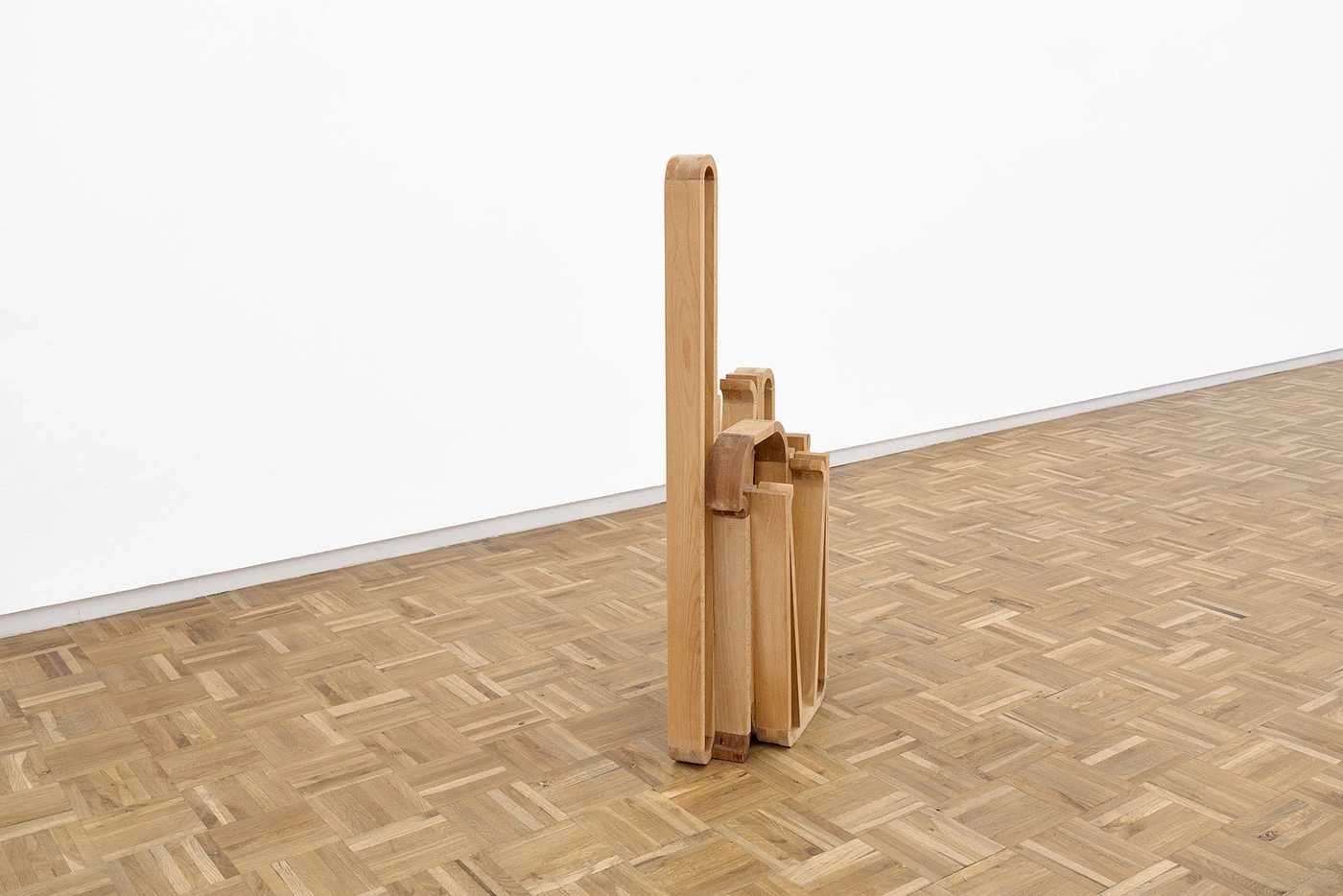
Unathi Mkhonto’s practice resists the easy seduction of resolution. What gives it its consistent allure is precisely that refusal: he does not approach space as something to be corrected, beautified or stabilised, but as something to be read, slowly, intuitively, and often against the grain. In his work, architecture is evidence, atmosphere and the residue of human conditions, of violence, memory, rupture and endurance. What appears at first to be a formal engagement with structure and material reveals itself, more insistently, as an inquiry into what space holds, what it conceals, and what it remembers.
That sensibility feels inseparable from where he comes from. Growing up in Peddie in the Eastern Cape, Mkhonto describes an early environment marked by the absence of dense buildings and crowds. This origin point matters because it complicates any straightforward reading of his practice as being about the built environment alone. If anything, his relationship to architecture begins elsewhere, in distance, in lack, in the quiet clues left behind by how people inhabit or fail to inhabit place. Peddie, as he puts it, grounds the work. It gives him a way to return to himself, and to the work, in search of visual and emotional clues rather than fixed answers. That return is part of the allure too: the practice feels anchored without becoming static, introspective without collapsing inward.
There is something deeply compelling about the way Mkhonto speaks about spatial violence. He locates it not in spectacle, but in the human condition. Rather than confronting violence through direct representation, he approaches it delicately, even obliquely. This restraint gives the work its charge. He is interested in building worlds, full worlds, as he says, worlds that have been through things. That phrase is telling. His works do not present pristine systems or neatly resolved environments; they arrive weathered, layered, carrying contradiction. Opposites and contrasts are not incidental features in his practice but structural principles. They are what bring the work to life.
This is where his interest in collage becomes especially potent. If cities live, as he suggests, then they also accumulate scars, improvisations and competing surfaces. Collage allows him to think through that instability. The image of a shop façade layered over a mineshaft, or graffiti painted across a permanent landmark, captures the logic of his practice with precision. Space is not singular. It is sedimented. It is revised by labour, by power, by time, by use. Mkhonto’s collaged spatial language understands that the city is never one thing at once. It is always multiple, fractured and becoming. His work does not flatten those tensions; it keeps them active.
His choice of materials sharpens this position. Cardboard, wood and paper are not neutral supports in his practice; they are conceptually and emotionally loaded. Mkhonto describes having found his language “between hardness and fragility,” and that formulation lands with unusual clarity. These materials carry both weight and precarity. They can suggest construction and failure, shelter and dispossession, permanence and collapse. In allowing the material to do what it does, he sidesteps mastery in favour of responsiveness. His comparison to Matisse cutting paper to make paintings is revealing: the act of cutting becomes not just a technical process but a way of drawing structure out of vulnerability.
There is also a political intelligence in his use of so-called unpleasing materials. “Cardboard is not pleasing to everyone,” he says, “but neither is our history.” It is a striking line because it refuses aesthetic comfort. His materials are not merely economical or found; they are argumentative. They insist that beauty cannot be detached from abrasion, and that form cannot be separated from the conditions that shape it. In Mkhonto’s hands, architecture materials are stripped of their expected function. They are meant to labour, to fix, to hold things together, yet he redirects them toward ambiguity, emotion and imperfection. That reversal is one of the most arresting aspects of his practice. He takes the language of utility and makes it speak about feeling.
What endures in his work is this tension between formal control and emotional openness. He speaks of creating an energy and atmosphere in the room, of making work in the real world, of opening himself up completely. There is no interest here in detached formalism, even when the work is rigorously composed. Nor is he seduced by the abundant vocabulary of modernism for its own sake. For Mkhonto, emotion is not secondary to structure; it is embedded within it. His practice suggests that form can carry grief, pressure, tenderness and contradiction without becoming illustrative.
Even the absence of the human figure in much of his work does not register as a lack. If anything, it becomes an opportunity to heighten the presence of human gestures elsewhere, through scale, through spatial tension, through material intimacy, through the echo of sound, film and everyday moments. The body is not always represented, but it is continuously implied. His spaces bear the marks of human negotiation. They breathe with proximity, labour, disappearance and memory. In this sense, the absence of figures does not evacuate humanity from the work; it makes humanity more ambient, more haunting, more structurally felt.
The consistent allure of Mkhonto’s practice lies in this rare ability to hold contradiction without forcing closure. His work is grounded but searching, delicate but unsparing, materially modest but conceptually expansive. It draws viewers in not by declaring answers, but by deepening the terms of attention. To spend time with his practice is to be reminded that space is never empty, that materials remember, and that the most affecting artistic worlds are often the ones that do not try to solve the conditions they confront, but instead teach us how to stay with them, look harder, and feel their weight.