

Contributor: Unathi Mkonto (Artist)
Format: Exhibition walkthrough
Exhibition: If Johannesburg Had a Beach, Who’d Go?
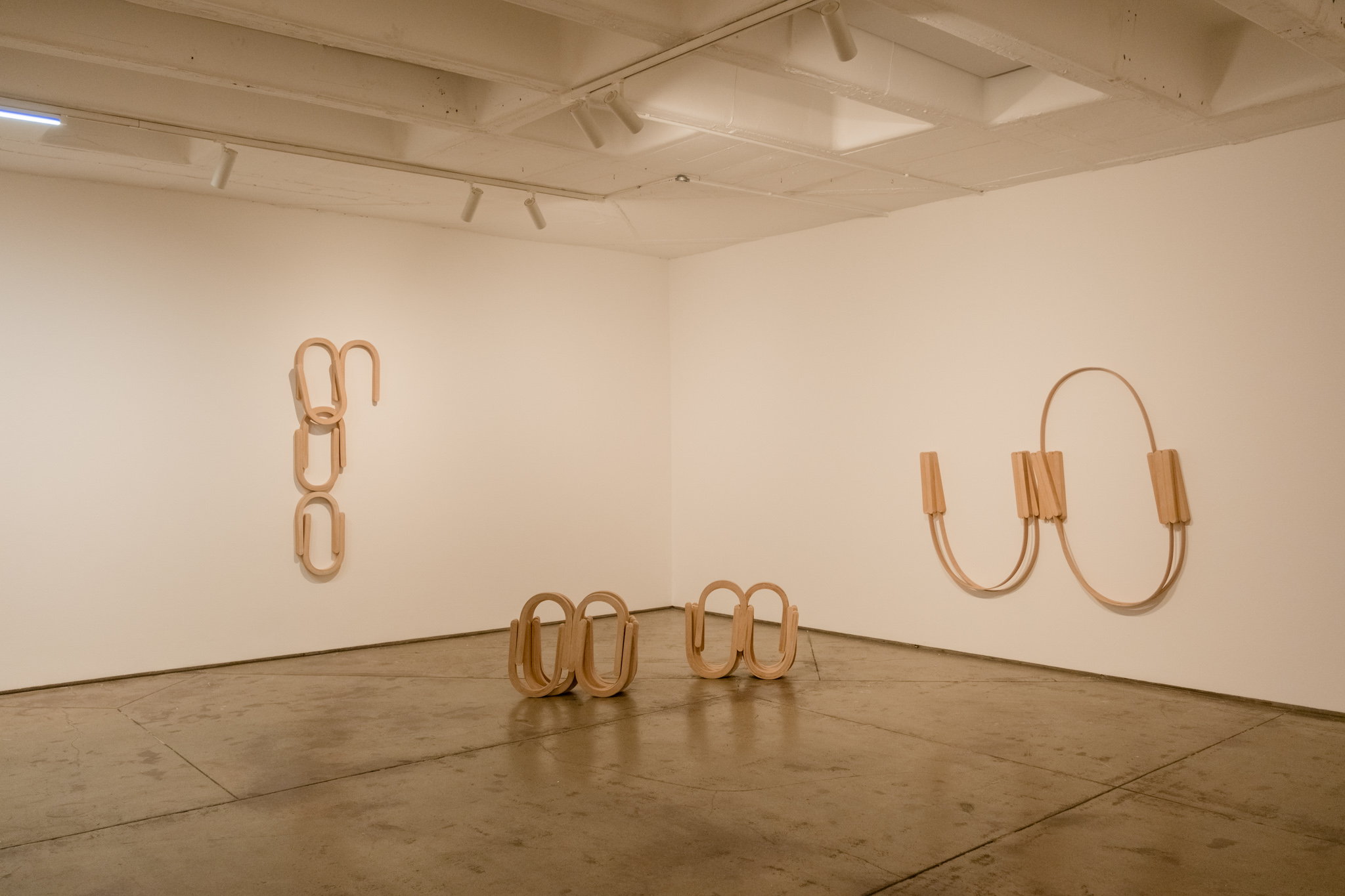
Presented as part of Bending Mediums, Unathi Mkonto’s exhibition If Johannesburg Had a Beach, Who’d Go? invited members into an imagined city suspended somewhere between architecture and ocean, memory and possibility. Working across drawing, sculpture, installation and architectural thinking, Mkonto uses abstraction to explore how people move through space, how cities generate energy and how imagination can become a tool for rethinking the built environment.
Drawing on Johannesburg’s inner city as both a physical and symbolic centre, the conversation unfolded through questions of movement, access, materiality and collective belonging. What emerged was not a proposal for what cities should be, but an invitation to imagine what they could become.
Cities are sustained through collective energy
At the heart of the exhibition is the idea that cities function much like oceans. Both are systems of movement, connection and circulation, animated by invisible energies that ripple outward from a centre.
For Mkonto, Johannesburg’s CBD represents a source point from which cultural, social and economic energy radiates across the city. The exhibition proposes a return to this centre, not through nostalgia, but through a renewed investment in collective life.
“The city energy is generated in the city centre.”
Rather than viewing the city as fragmented, the exhibition asks what becomes possible when people gather, connect and generate momentum together.
The beach as a question of access
The exhibition’s title begins with a playful hypothetical but quickly opens onto larger questions about leisure, labour and belonging.
Who gets to go to the beach? Who has time to rest? Who has access to spaces of recreation and pleasure?
For Mkonto, these questions inevitably connect to South Africa’s spatial realities, where movement through the city remains unevenly experienced.
“It’s a way to also look at class in the title and who gets to go to the beach.”
The beach becomes less a destination than a framework for thinking about privilege, access and the ways people inhabit urban space differently.
Drawing becomes architecture
Although trained as an architect, Mkonto approaches architecture less as construction and more as a way of thinking.
Throughout the conversation, he described a process that begins with a point. A point becomes a line. Lines become passages. Passages become walls. Walls become buildings.
The exhibition abstracts this architectural language into a series of sculptural forms that oscillate between structures, organisms, waves and imagined habitats.
What emerges is architecture stripped of function and reimagined as a language of possibility.
Emotional rather than functional structures
One of the most compelling ideas to emerge from the evening was Mkonto’s distinction between functional architecture and emotional architecture.
Rather than designing buildings that solve practical problems, he creates forms that generate feeling, curiosity and reflection.
“My work is not functional. It’s emotional.”
The sculptures do not dictate how they should be understood. Instead, they create space for viewers to project their own associations, memories and experiences onto them.
In this sense, the works operate less as objects and more as invitations.
Imagination over solutions
Mkonto spoke candidly about his hesitation around art that promises answers.
Having observed the language of certainty and solutionism that often surrounds architecture, sustainability and urban planning, he has become increasingly interested in the possibilities opened up by uncertainty.
“I’m not here to solve problems.”
Rather than offering fixed conclusions, the exhibition encourages viewers to think alongside the artist. Abstraction becomes a method for asking questions rather than delivering resolutions.
This openness allows the work to remain active long after leaving the gallery.
Material experimentation as research
The sculptural forms in the exhibition are the result of years of experimentation with bending plywood, structural systems and material behaviour.
Working with beech wood and specialised bending ply, Mkonto has developed a process that allows rigid materials to assume fluid, wave-like forms.
Yet material research is never purely technical. For Mkonto, experimentation becomes another way of thinking through ideas.
As with drawing, making is a process of discovery.
“I’ve been testing it over the years.”
The resulting works hold a productive tension between precision and play, engineering and intuition.
Responding to place
Although Mkonto’s practice engages broader questions of architecture and urbanism, each project begins with a particular site.
The exhibition emerged from an engagement with Johannesburg specifically: its towers, its density, its movement and its contradictions.
Rather than applying a universal framework across different contexts, Mkonto approaches each city as possessing its own character, history and rhythm.
The result is work that remains deeply attentive to place while resisting literal representation.
Why this mattered
For members, If Johannesburg Had a Beach, Who’d Go? offered a compelling example of how contemporary artists use abstraction to engage urgent questions without reducing them to straightforward statements.
The exhibition demonstrated that architecture can be emotional, that cities can be understood through metaphor and that imagination can function as a serious form of inquiry.
For collectors, the conversation also provided a valuable reminder that contemporary art is not always concerned with providing answers. Sometimes its significance lies in its ability to expand how we see, think and relate to the world around us.
As Mkonto reflected, the work is ultimately an invitation.
“I’m also asking people to help me think.”
In that invitation sits the exhibition’s greatest proposition: that reimagining a city begins not with certainty, but with curiosity.