

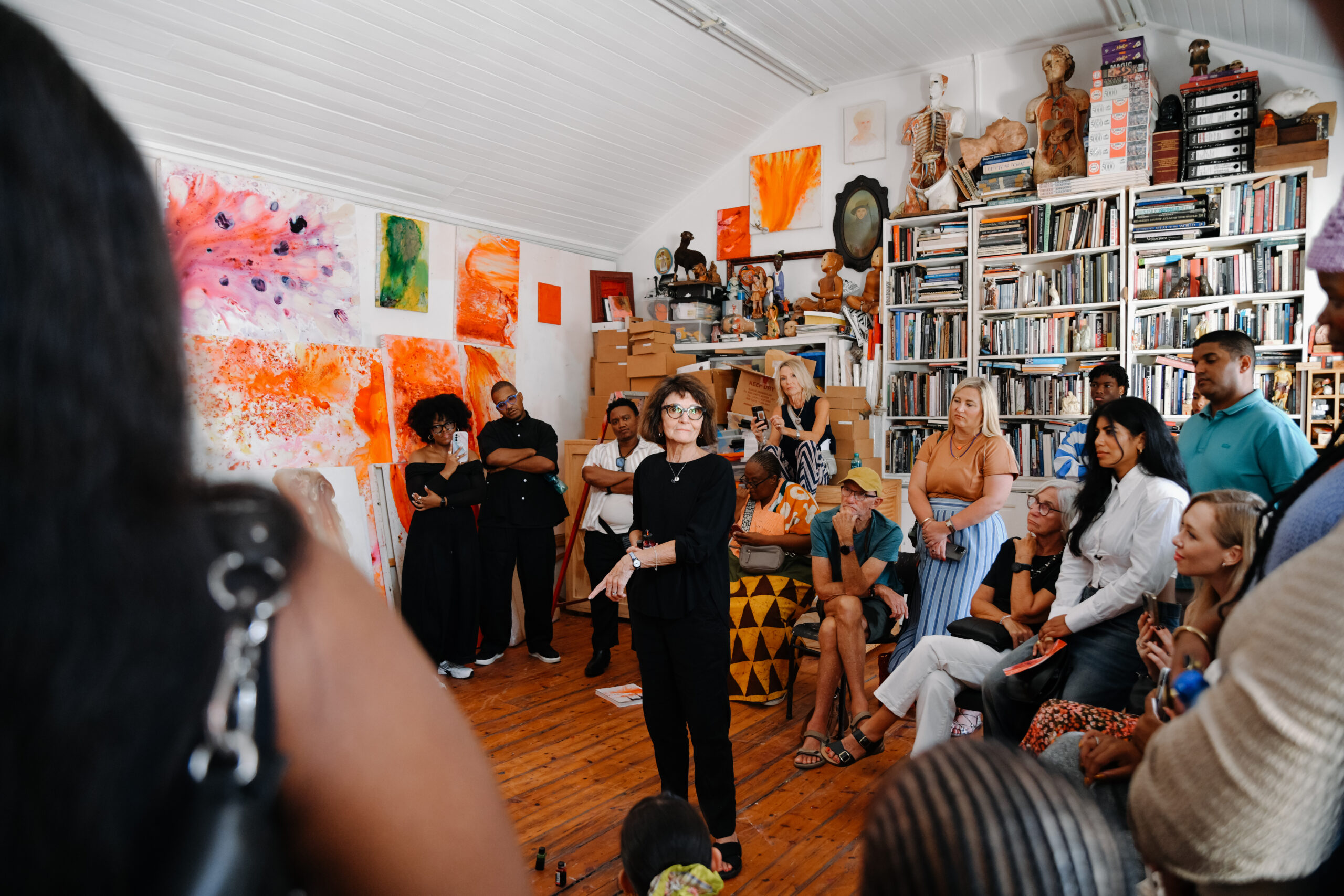
Contributor: Penny Siopis (Artist)
Exhibition: Love in a Turning World
Encountered first in the gallery and then in the studio, Penny Siopis’s practice unfolded as an immersion in material, affect and relation which she describes as a “position” of vulnerability and openness to the world. Across painting, installation, film and assemblage, works emerged through a call-and-response between intentional gesture and the agency of glue, ink, oil, weather, gravity and time.
Framed through Love in a Turning World, the visit proposed love not as a pictorial subject, but as a way of being in relation to others, to materials, to history and to instability itself.
Key reflections from the visit included:
1. Love as a disposition, not an image
“For me, love is a disposition rather than a subject matter,” Siopis explained. Rather than illustrating love directly, the works ask how openness, empathy and vulnerability might operate materially and socially. In a moment shaped by conflict and uncertainty, love becomes less sentiment than method: “a way of being in relation.”
For young collectors, this offers an important shift in perspective: contemporary art is not always about fixed meaning or immediate readability. Sometimes its value lies in how it expands our capacity to think, feel and remain open.
2. The material has agency
Central to Siopis’s practice is the idea that materials are collaborators rather than passive tools. Glue cracks, ink bleeds, pigments shift and surfaces transform unpredictably over time. “The materials are so subject to change,” she noted, describing the process as both risky and alive. Rather than controlling every outcome, Siopis works responsively, allowing accidents and transformations to shape the final work. The result is painting as process rather than a static image.
For emerging collectors, this is a reminder that process matters. Understanding how a work is made can fundamentally deepen its meaning and significance.
3. Atlas and the idea of collectivity
The exhibition opened with Atlas, an ongoing series begun during lockdown in 2020. Installed as a grid, the works function simultaneously as individual paintings and part of a larger collective structure.
“They’re like individuals in a crowd,” Siopis reflected. “None of those single entities are works in and of themselves. They only come into being through the larger corpus.”
The series draws loosely from Aby Warburg’s Mnemosyne Atlas, where meaning emerges through relation, accumulation and juxtaposition rather than singular narrative. For collectors, this offers another useful framework: artworks often speak not only individually, but in dialogue with other works, histories and contexts.
4. Research as imagination
Siopis spoke extensively about reading and research as liberating rather than restrictive. “I never feel oppressed by theory,” she said. “Reading is liberating. It’s like travelling in your head.” Her current research into cosmopolitanism, migration and the history of Thessaloniki informs both painting and film work, not through direct illustration, but through resonance and association. Facts become poetic triggers. This is especially important for young collectors engaging contemporary African art: theory, history and context are not separate from the work. They are part of the ecosystem that produces meaning.
5. Open forms and embodied looking
Across the exhibition, abstraction and figuration continuously shifted into one another. Surfaces suggested bodies, landscapes, weather systems, or memories without settling into certainty. Siopis described this as an “open form”: one capable of holding contradiction and vulnerability simultaneously. Viewers complete the work through their own looking, projection and emotional response. Collecting, in this sense, is not only acquisition. It is a long-term relationship with ambiguity, perception and change.
6. Assemblage and the afterlife of objects
Throughout the gallery, sculptural assemblages made from flea-market finds and studio remnants created strange, intimate encounters between unrelated objects.
“Unlikely objects get coupled,” Siopis explained. These found materials carry prior histories and emotional traces into the work, allowing meaning to emerge through juxtaposition rather than explanation. The works resist neat interpretation while remaining emotionally legible. For collectors, this reinforces the importance of intuition. Not every compelling work resolves itself immediately.
7. Relationality as philosophy
One of the most resonant ideas from the visit was Siopis’s understanding of artistic practice as fundamentally relational. “We are made of many, many other authors,” she reflected. Research, found footage, literature, conversations, memory, politics and materials all enter the work simultaneously. The artist becomes a less isolated creator than a medium through which multiple voices and forces converge. This relational thinking extends to collecting itself. Collections are not neutral accumulations of objects; they are evolving systems of connection between artists, histories, ideas, spaces and people.
8. Why this mattered
For members, Love in a Turning World reframed painting and installation as living, unstable, relational practices. Colour became bodily. Time became material. Meaning remained deliberately in motion. In a moment marked by global instability, Siopis’s work proposed vulnerability not as weakness, but as a condition for empathy, imagination and transformation. “Anything is possible in the imagination,” she reflected, describing the way pigments explode, merge, separate and reform across the canvas surface.
For young collectors, the visit offered something equally valuable: permission to approach art slowly, relationally and without needing immediate certainty.