

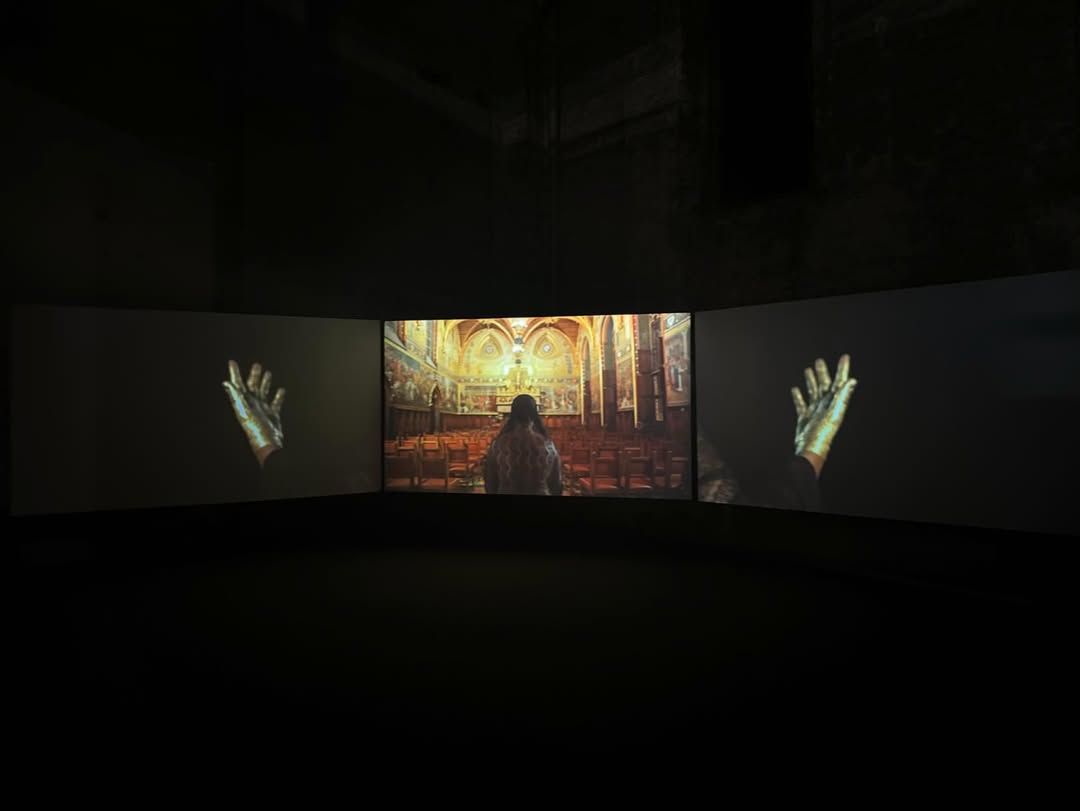
Koyo Kouoh’s In Minor Keys clarified the terrain for a contemporary African art fair. Venice did not merely include African and diasporic perspectives; it arranged itself around them. What registered most strongly was not scale or spectacle, but the precision with which attention was handled. Rest, pacing and legibility were treated as infrastructural concerns rather than atmospheric additions, while material intelligence and historical accountability operated as central organising principles. The authority of the exhibition emerged from how deliberately it staged encounters and how carefully it protected the conditions under which those encounters could unfold.
What became visible through this approach was the relationship between tempo and value. Slower pacing appeared to deepen engagement rather than dilute intensity. Works were given room to accumulate meaning over time, and viewers were allowed to arrive at practices gradually rather than through overload. The exhibition suggested that attention itself is a medium that can be curated, directed and protected.
Material culture also carried a particular weight throughout the Biennale. Craft and process did not function as embellishment or supplement, but as argument. Techniques associated with clay, textile, wood, metal and other forms of making operated as repositories of memory, labour and historical continuity. Process became legible as both method and inheritance, allowing making to hold conceptual and political force without separating itself from form.
Questions of belonging moved similarly beyond theme into structure. Across multiple presentations, histories of migration, ritual, labour, language and land were not framed as discrete identity concerns but as conditions shaping aesthetic form itself. What emerged was an understanding of African and diasporic practice not as a category seeking inclusion, but as a framework capable of organising discourse, space and institutional attention on its own terms.
Performance and live work also appeared differently within this context. Rather than relying solely on provocation or disruption, several projects approached the body as a site of ritual, vulnerability, repair and collective memory. The effect was not quieter, but more exacting. Live practices were able to sustain complexity because they were supported with time, context and spatial care.
The Biennale also revealed how decisiveness can produce greater authority than excess. Some of the most memorable presentations relied on restraint: a single immersive installation, a carefully paced room, a materially concentrated gesture. Ambition was not communicated through accumulation, but through precision and clarity of intent. Scale felt most effective when it was matched by focus.
Equally significant was the sense that institutional authority now travels through continental and diasporic networks rather than singular centres. The visibility of African practices across the exhibition reflected not only curatorial inclusion, but years of circulation between artists, producers, scholars, patrons and independent infrastructures across cities and regions. Venice made visible the extent to which these ecosystems already shape global contemporary art discourse.
Underlying all of this was the role of knowledge infrastructure. Reading rooms, archival gestures, sound works and spaces of pause suggested that interpretation and context are not secondary to exhibition-making, but constitutive of it. The exhibition positioned scholarship, listening and reflection as part of the conditions through which cultural value is produced and understood.
Most importantly, In Minor Keys demonstrated what occurs when an African-centred curatorial vision sets the terms rather than responds to them. Institutions, audiences and markets recalibrated around that vision. The exhibition did not appear burdened by translation anxiety or the need to justify its frameworks externally. Its confidence came from assuming the legitimacy of its own epistemologies from the outset.
What remains after Venice is less a set of directives than a sharpened recognition of what contemporary African cultural infrastructure can hold. Not simply representation, but orientation. Not visibility alone, but authority over pace, form, memory and encounter. The implications of that shift extend beyond the exhibition itself and into the ways fairs, institutions and markets on the continent continue to imagine their own role.