

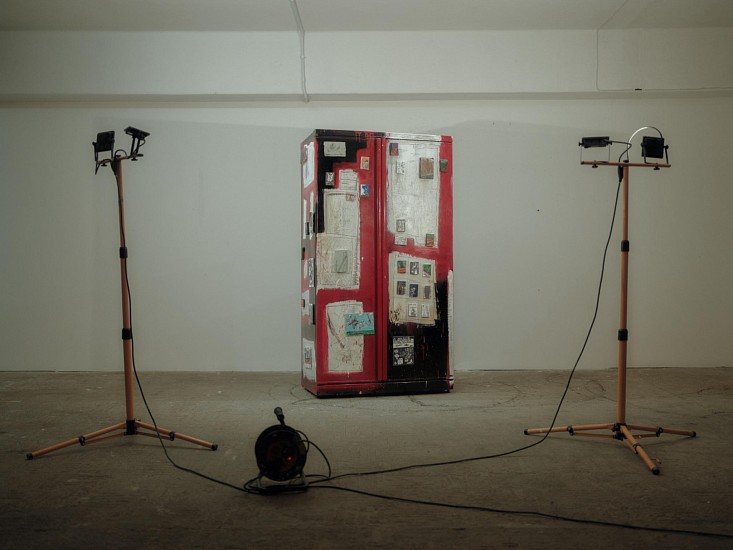
Everything happens at the same time. Conflict, regression, disappointment and violence do not ask for space before they occupy it. Whether experienced directly or witnessed at a distance, they colour the day and shape how people move through it. Before one event can be processed, another arrives. The present increasingly feels less like a sequence and more like an accumulation.
It is in response to this condition that Boytchie describes the making of Righteous Orders, currently on show at Everard Read Johannesburg. Speaking about the body of work, the artist explains: “I was inspired by the increasing rate of conflict in the world, I wanted to paint everything I saw so I kept producing new works quite rapidly.”
The works were not approached one at a time, resolved and then set aside. They were made in parallel, across overlapping timeframes, as though the logic of sequencing no longer applied. This matters, not as process for its own sake, but because it mirrors the condition the exhibition seems to be working through: the difficulty of separating one event from another when everything arrives already entangled.
Boytchie is an artist working within a visual language he describes as “loose abstraction.” In Righteous Orders, that looseness is not simply stylistic. It appears as uncertainty in form, in figures that do not fully stabilise, in marks that hesitate between image and gesture. Alongside this abstraction, recognisable symbols persist: the city, bodies, fragments of authority. They appear and recede, rinsed, repeated and worn out by the very systems they
The press material situates the work within a language of global instability, colonial continuity, and the repetition of historical violence under new names. It also points to something more specific: the exhaustion of moral language. Phrases that once carried weight, like “Never Again,” are presented as worn down by repetition, absorbed into the very systems they were meant to resist.
There is a question that runs underneath this, even if it is not stated directly: what happens when political language no longer interrupts the thing it names?
The exhibition does not try to resolve this. Instead, it returns to imagery that feels familiar enough to be recognisable but unstable enough to resist closure. Violence is present, but not contained in a single geography or moment. Power is present, but not explained through a single figure or structure. Meaning remains distributed.
Boytchie’s engagement with archival material is part of this. The press release references photographic documentation of war and historical studies of weapons and conflict. These are not treated as background references but as part of the visual logic of the work itself. What emerges is not a linear reading of history, but a sense of recurrence. Images repeat with slight variation until difference becomes difficult to locate.
This is where the exhibition’s relationship to time becomes important. Historical distance collapses into proximity. Events that should be separated begin to resemble one another. It is not only that history repeats, but that it appears increasingly difficult to tell where one cycle ends and another begins.
Within this, the shift in Boytchie’s practice becomes visible. Earlier iterations of the KA$H OUT series were often structured around more defined compositional systems, even when depicting collapse. Here, that structure loosens. Paintings feel as though they are being interrupted by themselves. Drawing returns, but without the stabilising function of outline. Colour and gesture begin to carry more of the image than the image itself.
It would be easy to read this as a move toward abstraction in the conventional sense, but that framing feels slightly insufficient. What is being staged is not a retreat from figuration, but a condition in which figuration cannot hold for long enough to settle.
The risk in an exhibition like this is that political content becomes a kind of interpretive shortcut. Military imagery signals war. Uniforms signal authority. Bodies signal consequence. But Righteous Orders does not stay at the level of signal. It keeps undoing its own readability. Symbols do not resolve into statements. They remain unstable, sometimes almost generic, as though stripped of context through repetition.
This instability extends to the title itself. A “righteous order” implies moral clarity, or at least the claim to it. Yet the works resist that clarity. They sit in the gap between justification and observation, between the language used to describe violence and the difficulty of accounting for it without reproducing its logic.
At its core, the exhibition seems less interested in declaring what power is than in staying with how power appears, disappears, and reappears across different registers of image-making. In that sense, it is as much about visibility as it is about violence. What can be seen, what can no longer be seen clearly, and what remains recognisable only through repetition.
What remains after moving through the exhibition is not a singular reading, but a sense of pressure. Not resolution, but accumulation. A reminder that the present does not arrive in order, and that looking itself has become a way of managing overlap rather than separating meaning.