

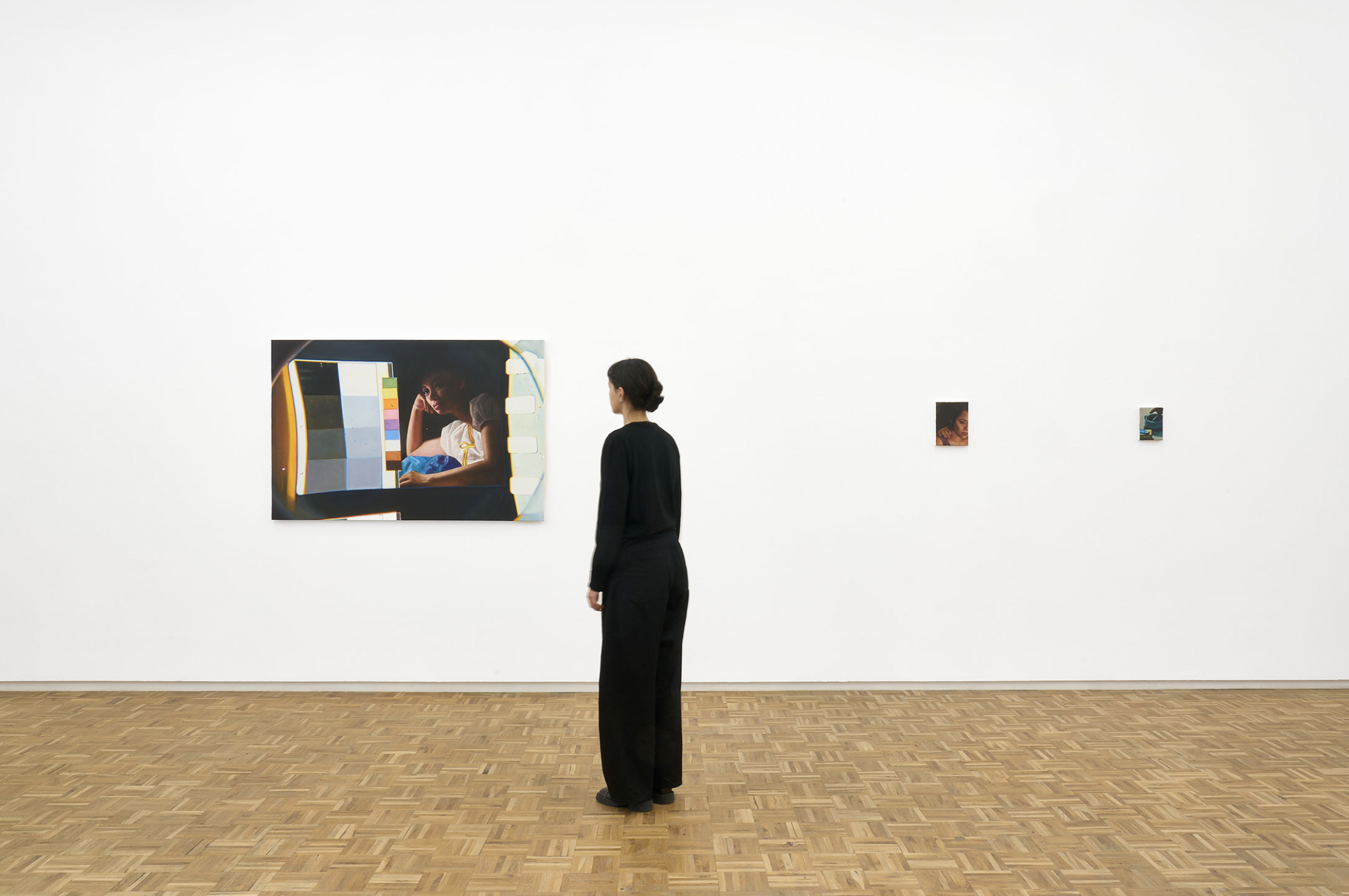
Annabelle Agbo Godeau’s solo exhibition Aperture brings to mind the generation effect—the idea that meaning forms not through passive reception but through the act of remaking. The generation effect refers to how much more deeply information is processed when it is actively produced rather than simply received. Like reading lyrics after hearing a song countless times. Photographing a scene first registered by the eye. Writing minutes from a meeting. Mapping ideas to make sense of them. Transcribing textbook notes so that the body assists the mind in remembering.
Agbo Godeau’s practice operates within this logic. Her work is rooted in painting, specifically small-format oils on canvas. These paintings begin not in invention but in retrieval—images already seen, already composed. She sources her material from film stills drawn from what she refers to as “mystery movies,” including auteur cinema and horror films. The process involves pausing, isolating, and excising fragments, which are then repainted with precision and restraint. The result is not repetition but transformation. Images are slowed down by the hand. The waxy, layered surfaces recall the texture of analogue film, evoking the chemical and material processes of an earlier visual technology.
Texture plays a central role. The paint builds up like skin or sediment. Layers remain visible at the edges, where materiality overtakes illusion. Yet the scenes themselves remain suspended. Each painting holds a moment mid-breath—fragments cut from a narrative that no longer holds. Recognition flickers but doesn’t settle. These are familiar gestures, moods, angles, but the context is gone. What remains is suggestion.
The exhibition’s title, Aperture, reinforces this relationship between image and absence. In technical terms, an aperture is the opening in a camera lens through which light passes to form an image. But the word also suggests a gap, a breach, a space between. Agbo Godeau works within this space—between the moment something is seen and the moment it is understood. Her paintings hint at cinematic continuity while refusing it, inviting the viewer to speculate, to reorder, to fill in what’s missing.
This speculative mode becomes even more pronounced in the exhibition’s second body of work, where she introduces visual systems once used in film calibration. Known as “leader ladies,” these archival test images—used for colour grading in film labs—appear alongside cinematic fragments in new composite compositions. Elements once intended for technical measurement—grids, scales, calibration charts—are absorbed into the visual language of painting. Their original function is dissolved, reconfigured into formal, narrative, and symbolic structures. The logic of the film lab becomes material for the canvas.
These works do not reference—they regenerate. Agbo Godeau brings together mechanisms of seeing and traces of surveillance, technical standards and emotional cues, and reorders them through the logic of painting. The result is not a faithful reproduction but a system of clues. Portable and modular, these images suggest infinite arrangements. Narrative becomes something provisional, co-produced in the act of looking.
The reference to trompe-l’œil is not one of deception but of doubt. These are not illusions, but prompts. What is being seen? What is being recognised? What is being constructed in the mind of the viewer?
Aperture suggests that vision alone is not enough. Understanding requires engagement. It requires making.