

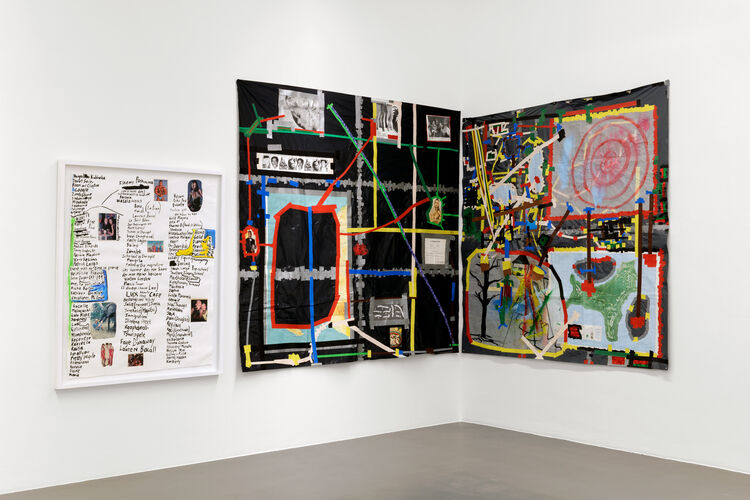
A place can shape a life long before it appears on a map. It can live in the memory of a landscape, in the stories passed between generations, in the routes taken to get home and in the small details that make somewhere recognisable to the people who belong to it. When South African artist Moshekwa Langa encountered official maps that did not include Bakenberg, the town in Limpopo where he grew up, an absence became something to think through. What does it mean for a place to exist so fully in the lives of its inhabitants, yet remain unaccounted for in the records used to describe the world? At Kunstinstituut Melly in Rotterdam, You will find us in the best places, a major survey of Langa’s practice, returns to the questions of place, memory and representation that have accompanied his work across three decades.
Featuring nearly 120 works and occupying the entire building, the exhibition offers the largest overview of Langa’s work to be presented in the Netherlands, where he has lived for more than 25 years. Curated by Gabi Ngcobo, director of Kunstinstituut Melly, with curator Kabelo Malatsie, the exhibition brings together works made across different periods of the artist’s life. Rather than arranging this history into a sequence of beginnings, developments and conclusions, it follows the ideas that return throughout his practice. The result is an encounter with time as something less orderly than a line, where earlier concerns remain present, reappear in different forms and gather new meanings with each return.
Langa emerged as an artist during the early years of post-apartheid South Africa, when the end of apartheid and the lifting of cultural isolation opened new possibilities for exchange with the international art world. His participation in the Johannesburg, Havana and Istanbul biennials in 1997 marked an early moment in a career that would continue across major international exhibitions, including São Paulo, Gwangju and Venice. That same year, he moved to the Netherlands to join the Rijksakademie van Beeldende Kunsten residency, seeking an artistic community that could challenge and inform his practice without requiring it to settle into an easily recognisable category.
The movement between places is one part of Langa’s story. Yet geography, in his work, extends beyond the distance between one country and another. The omission of Bakenberg from official maps points towards a deeper question about how places are made visible, who has the authority to represent them, and what happens to the lives that fall outside those representations. Under apartheid, mapping was inseparable from the political organisation of land, movement and belonging. Borders and official records helped determine who could occupy a place, who could move through it and whose relationship to the land would be recognised. Against this history, a missing town is more than a cartographic oversight. It reveals the distance that can exist between a place as it is lived and a place as it is officially recorded.
These concerns recur throughout Langa’s practice in forms that resist being contained by a single medium or interpretation. Lines woven across paper, installations made from spools of thread, bodies of water, childhood memories and observations of landscapes shaped by history all offer different ways of approaching the relationship between people and the places they inhabit. The work does not need to reproduce a map to ask what mapping makes possible, or what it leaves behind. Instead, these varied materials and gestures allow questions of land, memory and belonging to move between forms, acquiring new associations as they do.
There is also something revealing about the materials through which Langa approaches these questions. Coffee, nail polish, lipstick, staples, yarn, car varnish, newspaper, coal, refuse bags and tape belong to the ordinary world of things used, handled, discarded and overlooked. In his hands, they become part of a visual language whose complexity emerges through their material properties and the meanings they accumulate. A piece of newspaper already carries information and history; coal bears the traces of a landscape and its extraction; thread can connect, divide or mark a route. Such associations do not exhaust what these materials might become in a work, but they make clear how much meaning can reside in things that are often considered too ordinary to warrant sustained attention.
Langa’s use of everyday materials also complicates the idea that an artistic practice must follow a straightforward progression towards a final form. Some works begin and remain unfinished for years. Ideas recur, shift and start again. In the context of You will find us in the best places, this refusal of a fixed chronology becomes particularly significant. A survey exhibition often promises a comprehensive account of an artist’s development, a way of looking back and understanding how one body of work leads to another. Here, the curatorial arrangement offers a different possibility: to recognise continuity without insisting on a single direction, and to see how an artist can remain in conversation with questions that have occupied him for decades.
Perhaps this is where the exhibition’s relationship with memory becomes especially compelling. Memory rarely behaves like an archive in which every event has a settled place and every recollection can be retrieved in the order it occurred. It returns unevenly. A detail once overlooked becomes meaningful years later; a place remembered from childhood changes as new experiences gather around it. Langa’s practice makes room for this elasticity, allowing ideas to persist without requiring them to arrive at a definitive conclusion. The recurring themes in his work are less like answers than points of return, each encounter offering another way to consider what is already known.
The exhibition’s title, You will find us in the best places, carries a quiet insistence. It suggests a presence that can be located, but perhaps not always where it is expected. The places that matter most may not be those recognised by official records, celebrated by institutions or easily translated into established categories. They may also exist in the materials people keep, the memories they carry, the routes they repeat and the knowledge held within communities. In this sense, finding a place is not always a matter of locating it on a map. Sometimes it requires learning to recognise the forms through which it continues to exist.
Across nearly 120 works, Langa’s survey invites a reconsideration of what it means to look back at an artistic life. Three decades can be gathered within a single building, but they cannot be reduced to a finished account. The questions that shaped an earlier work may remain active in a later one; a material may return with a different set of associations; a memory may become newly legible when placed beside another. What emerges is not a closed history of an artist’s practice, but an understanding of its ongoing life.
Bakenberg may have been absent from the maps Langa encountered, but its presence within his work suggests that a place does not begin and end with its official recognition. Places persist through the lives that remember them, the histories that shape them and the meanings carried forward by those who leave and return. At Kunstinstituut Melly, You will find us in the best places makes room for these continuities, tracing an artistic practice that remains open to the things that cannot be neatly located, conclusively recorded or left behind.