

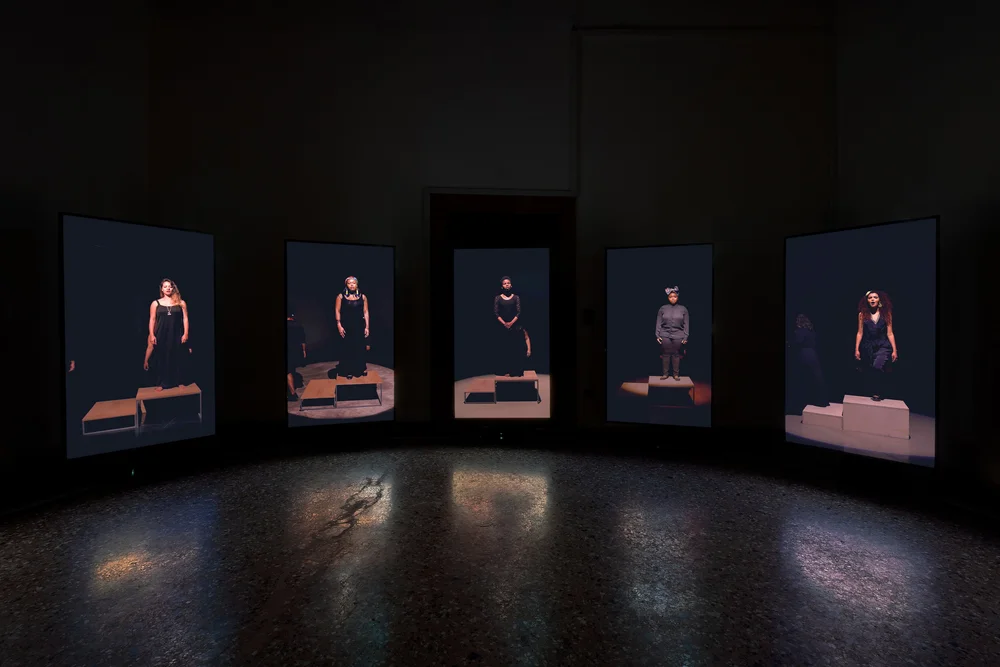
There is a hum before a lament begins. It is not silence, not yet sound. It is breath, that pre-mourning intake that draws the room into suspension and admits the possibility of tenderness. This is where Gabrielle Goliath’s Elegy begins: in the charged interval before voice, in the fragile threshold between grief and song. Exhibited in Venice after the erasure of the South African Pavilion’s official presence, Elegy arrived less as spectacle than as persistence, a refusal to vanish.
After the state withdrew its frame, the bureaucratic structure through which national identity might have been staged, Goliath carried the work to Venice independently, installing it at the Chiesa di Sant’Antonin. That gesture matters. It shifts representation away from state machinery and toward the artist’s own insistence. If the institution falls silent, the lament continues. Sustained by a group of Black femme vocalists, Elegy transforms the idea of a pavilion from a national display into a gathering of witness, mourning, and care.
Goliath’s medium is sound, but more precisely, resonance. Elegy is built not from objecthood but from vibration: voice meeting stone, grief meeting architecture, breath meeting breath. In each performance, singers call the names of women and gender-diverse people killed by intimate and systemic violence. Their mourning unfolds through extended vocalisation, often holding tones so long they seem to suspend time itself. The effect is not resolution but duration. Violence is not sealed off in the past; it is made present as something that still reverberates in the body.
This is what makes Elegy so affecting. Sound here is tactile. It presses against skin, moves through the chest, settles into the air. The singer’s body becomes a living archive, and the church becomes a resonant chamber of collective grief. The audience does not simply observe the work; they are caught inside it. Their breathing adjusts to it. Their listening becomes part of its structure.
Presented in Venice, Elegy also takes on a sharpened political charge. South Africa’s history at the Biennale has long been entangled with questions of legitimacy, visibility, and state narration. The cancellation of the official pavilion exposed once again the instability of cultural representation when it depends on bureaucracy. Goliath’s independent presentation offers another model. Rather than carrying a fixed image of the nation abroad, she carries a chorus, a collective act of remembrance for those so often excluded from national memory.
“Elegy is not tragic,” Goliath has said. “It is attentive, it is loving.” That distinction is crucial. There is no spectacle of suffering here, no easy catharsis. Instead, the work lingers in care, duration, and mutual bearing. The longer a note is held, the more fully grief is shared. Lament becomes an ethics of attention. Softness, in this context, is not weakness but endurance.
Venice intensifies these meanings. The city’s watery instability, its echoes, and the sacred acoustics of the church all deepen the work’s meditation on memory and vulnerability. In that setting, Elegy becomes more than a performance. It becomes a form of liturgy, a way of sounding the dead back into presence. The church, with all its histories of solace and violence, is briefly remade as a site of accountability.
In Elegy, sound becomes a way of living otherwise. It preserves what official records, public discourse, and institutional absence so often fail to hold. Rather than offer a stable image of South Africa, Goliath offers something more powerful: an echo, embodied and uncontained. Her work insists that mourning is not only remembrance but relation, not only grief but a way of building a world through care.
There is no true final note in Elegy. The song ends only when the body can no longer sustain the breath. That limit gives the work its emotional force. It acknowledges exhaustion, finitude, and difficulty, but also the will to continue carrying what must be carried together. In the wake of cancellation, Elegy stands as a more profound form of representation precisely because it rejects spectacle. It does not monumentalise loss. It keeps listening.
What remains after the performance is not silence as emptiness, but silence altered by what has passed through it. In that lingering atmosphere, Goliath’s work offers a quiet but radical proposition: that breath, lament, and attention may hold us where institutions fail. In Venice, Elegy did what the pavilion could not. It endured.