

There is something worth considering about the places from which we learn to understand the world. Some places enter our cultural imagination through the work of their artists, others through the institutions that preserve their histories, and others still through the people who insist on making room for different ways of living, thinking and creating. Botswana has been on my mind in this way, as a country whose contribution to contemporary African art deserves to be considered beyond the names we have come to recognise internationally.
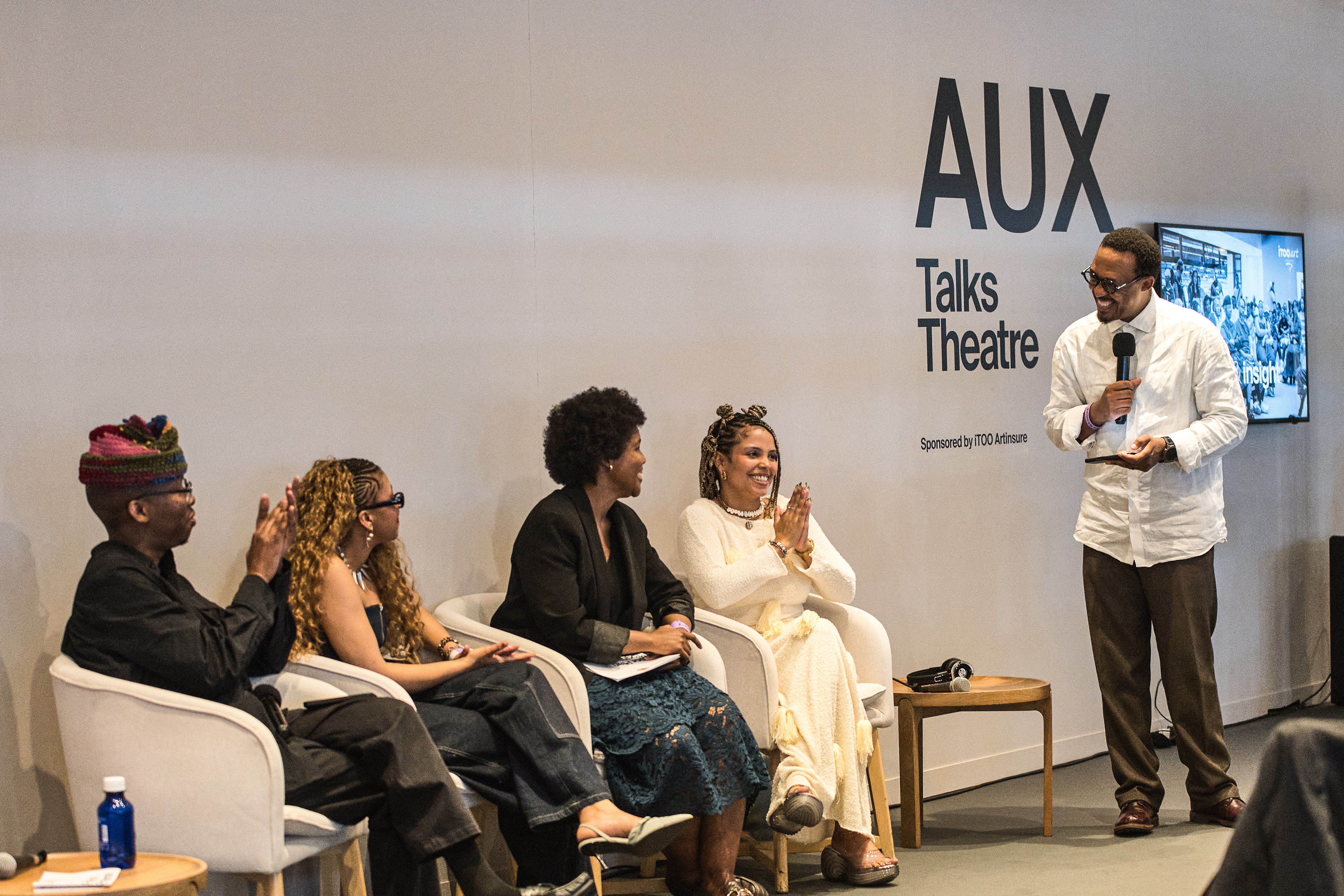
There are places that find their way into our imaginations long before we have the opportunity to know them for ourselves. Botswana was one such place for me. I grew up with fragments of it through the stories and musings of my late father, whose work took him there through the Southern African Development Community and the Bank of Botswana. Over time, those fragments became a quiet curiosity, a sense of familiarity with a place I had yet to encounter on my own terms. A few weeks ago, at the 19th edition of FNB Art Joburg, that curiosity found another point of departure when artists and cultural producers from Botswana engaged fairgoers during a talk titled The Quiet Frequencies of Botswana and What Comes Next. This reflection borrows its title from that conversation, which has stayed with me as an invitation to think further about the country, its cultural practitioners and the relationships that might still unfold.
My curiosity about Botswana’s contemporary art scene has grown through encounters with artists such as Meleko Mokgosi, Pamela Sunstrum, Kelebogile Marope and Katlego C.L. Twala, whose practices have offered me glimpses into the country’s wider cultural landscape. But I have found myself wanting to look beyond the work I have encountered and learn more about the people, conversations and conditions that shape its making. Who are the people nurturing these ideas? What are the cultural spaces and relationships through which they find expression? It was with these thoughts, and a growing sense of anticipation, that I travelled to Botswana to attend the Banana Club Economic Inclusion Forum as a member of the public.
My time in Gaborone offered a closer encounter with some of the people and ideas shaping this landscape. It also got me thinking about how easily a country’s cultural life can be reduced to the handful of associations through which it is most familiar to the outside world. Botswana is often spoken about in relation to its heritage, wildlife and tourism. These are meaningful parts of its identity, but they tell only one part of the story. Across the country, artists, designers, writers and independent cultural practitioners are engaging with questions of identity, politics, social change and contemporary African life.
For journalist, cultural producer, artist and founder of Banana Club, Tanlume Enyatseng, the relative absence of Botswana from major continental conversations is often mistaken for an absence of cultural activity. He is interested in challenging that assumption, particularly when the work and ideas already being developed within the country are overlooked. As he puts it, “Botswana’s cultural visibility should not be confused with its cultural value.”
It is a distinction that stayed with me. Conversations about Botswana’s cultural economy can become preoccupied with what is missing: major museums, established art markets, international festivals and institutional support. These are real considerations for practitioners trying to sustain their work, but they are not the whole picture. There is a danger in allowing what is absent to become the dominant way of understanding what is present. It can mean overlooking the intellectual, artistic and community-led activity already taking place. Enyatseng is cautious about describing Botswana’s cultural economy as perpetually emerging, a framing that can make it seem as though the country is always on its way to becoming something, rather than already contributing to contemporary cultural thought.
“Botswana is not simply an emerging market for culture, but a place where important cultural ideas and practices are already being developed,” he says.
This perspective informs Banana Club, the queer curatorial platform founded by Enyatseng. Through unconventional spaces and immersive experiences beyond the white cube, the platform reimagines how people encounter and participate in art. Its work considers not only where art is encountered, but the kinds of relationships that can form around it. It also invites us to consider who gets to shape the terms through which cultural value is understood, and why work produced within a particular context so often needs to travel elsewhere before it is taken seriously at home. These are questions that resonate well beyond Botswana.
Now in its second edition, the Banana Club Economic Inclusion Forum took as its 2026 theme, Access: Beyond Inclusion. Across three panel discussions on access to opportunity, capital and the digital future, the programme considered what it takes for people to participate meaningfully in the cultural economy. The distinction between access and inclusion matters. Being invited into an existing system does not necessarily mean having the resources or influence to reshape it.
The keynote conversation between Enyatseng and his contemporary, IB Kamara, centred on the question, “Who gets paid when culture travels?” Their exchange considered the movement of culture across borders, who benefits from it and whose authorship is allowed to shape the narratives that travel. Kamara is part of a generation of African-born practitioners reshaping how African identities, aesthetics and cultural references are represented within global fashion and visual culture. His work challenges conventional ideas of beauty, masculinity and identity, while creating greater visibility for perspectives and creative languages that have historically been marginalised within the international fashion industry. He has held influential positions across the industry, including Senior Fashion Editor-at-Large at i-D, Editor-in-Chief of Dazed magazine and Creative Director of Off-White.
Drawing on his own journey as an African artist born in Sierra Leone, raised in The Gambia and currently living in London, Kamara spoke about the importance of changing the gaze, embracing a global majority mindset and recognising Africa as a source of knowledge, imagination and possibility. He also reflected on the importance of building collectively, reminding us that the relationships formed between peers can become the very networks through which new cultural worlds take shape.
These ideas found a particular resonance in the wider conversations taking place at the forum. Questions of access, mobility, capital and collective support are not abstract considerations for Botswana’s cultural practitioners. They are part of the everyday conditions under which artists and independent cultural platforms make, share and sustain their work. Enyatseng speaks of a resourceful creative community navigating limited institutional support, access to capital and opportunities for international mobility. What he hopes to see is “more meaningful continental collaboration” that moves beyond showcasing talent towards lasting partnerships, shared resources and economic opportunities.
While it was central, the teachings and plantings of my time in Botswana took seed beyond the forum. Some took place with the windows rolled all the way down during taxi rides through Gaborone and, in part, Odi, with a driver recommended by a friend. Others came through a drive around the city with Lerato Motshwarakgole, founder and director of Ora Loapi, whose perspective offered another way of thinking about the place and the people shaping it. There was something generous about these encounters, about learning a city through the conversations that unfold while moving through it, rather than only through the places marked out on an itinerary.
I was also reunited with an old friend, Brilliant Kodie, whom I first met in 2019 during the press run for Meanwhile, an anthology of queer life in Southern and East Africa to which he contributed. Reconnecting with him brought another kind of continuity to the trip. Some conversations happened on the dance floor; others on walks to second locations, in those in-between moments when the evening has not quite ended and nobody is in a hurry to go home. These encounters reminded me that cultural exchange is not always organised around a programme or a formal invitation. Sometimes it happens through friendship, movement, shared histories and the willingness to spend time with one another.
I found myself thinking about what it might mean to take this kind of collaboration seriously, not as a once-off exchange or an invitation to participate in someone else’s programme, but as an ongoing relationship between cultural communities. There is so much to be gained from knowing what is happening beyond the places and people we encounter most often. The forum offered a glimpse into the conversations already taking place in Botswana, while the other encounters gave those conversations a life beyond the room, connecting ideas to the everyday rhythms and relationships of the city.
Kelebogile Marope’s selection as the 2026 FNB Art Prize recipient, making her the first Botswana-based artist to receive the award, offers one point of connection between Botswana’s contemporary art scene and a wider continental platform. But what interests me is not only the moment of recognition itself. It is what might follow: the conversations it opens, the relationships it makes possible and the ways in which artists and practitioners might continue to find one another.
I left Gaborone thinking about the conversations that had begun there, and about all the conversations that might still happen if we allowed ourselves to move more freely across the continent. My time in Botswana has left me excited by the possibility of instigating more border-defying cross-pollination between our cultural communities. I want to see what might emerge when artists, writers, curators, designers and institutions encounter one another outside the familiar circuits of exchange; when knowledge travels, friendships take root and ideas find new places to grow. Not every encounter needs to lead somewhere immediately. Sometimes it is enough to be in a room, to listen, to recognise a shared curiosity and to leave with a different sense of what might be possible.
Botswana has given me more to think about, but also more people and practices to remain in conversation with. I return to Johannesburg with a desire to keep those conversations moving, and to contribute to a cultural landscape in which our connections are not limited by the borders we have inherited.