


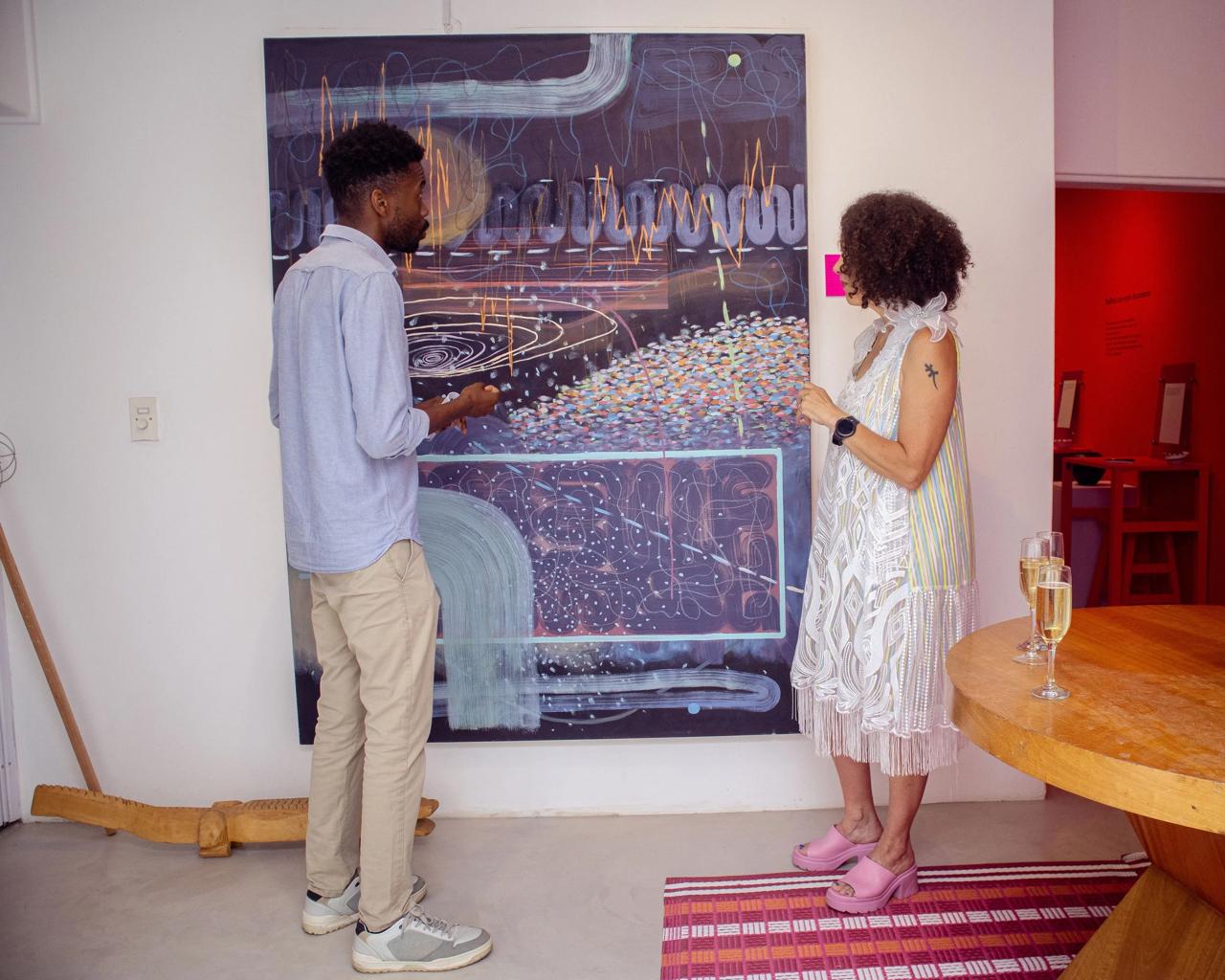
At a moment when contemporary African art is increasingly visible on the global stage, questions of infrastructure, care, and context remain unresolved. Visibility, after all, does not automatically translate into sustainability. As Ngaire Blankenberg observes, we are living through “a deeply unglamorous crisis,” one in which the basic conditions that allow heritage institutions to function,staffing, maintenance, continuity,are quietly eroding. Against this backdrop, A42 House positions itself not simply as a cultural destination, but as an intervention into how heritage, creativity, and community might be held together differently.
Founded by the not-for-profit Institute for Creative Repair, A42 is framed as a pan-African brand, though its ambitions extend beyond branding in the conventional sense. Blankenberg’s thinking emerges from years spent inside global museums, where she came to understand that institutions “turn memory into organized knowledge,” and that this organization is itself a form of power. Working with young artists, designers, makers, storytellers, filmmakers and technologists, A42 seeks to transform small museums, heritage sites, cultural villages and artist-run centres into what it terms “regenerative creative destinations.” The language here is deliberate. Regeneration suggests a process rather than a product, a commitment to continuity rather than extraction.
Globally, there are precedents for this kind of hybrid cultural model. Initiatives such as Fogo Island Arts in Canada, which integrates artist residencies with community-led hospitality, or Japan’s Benesse Art Sites on Naoshima, which fuse contemporary art, architecture and tourism, offer examples of how art can anchor regional renewal. Similarly, institutions like Hauser & Wirth Menorca or the LUMA Foundation in Arles demonstrate how cultural capital can be mobilised to revitalise peripheral or post-industrial sites. Yet these models are largely shaped by Global North conditions: access to capital, established tourism flows, and relatively stable heritage infrastructures.
A42 operates within a markedly different terrain. Across much of the continent, Blankenberg, founding director of the Institute for Creative Repair and founder of A42, argues that “our public museums and heritage sites are simply not working,” not because of a lack of talent or policy, but because of institutional failure and short-termism. African heritage sites are often under-resourced, fragmented by colonial legacies, or excluded from dominant cultural economies altogether. In this context, A42’s concept of “micro-heritage resarts” becomes significant. The term resart, a portmanteau of residence, resort and art space, signals a refusal to separate leisure from learning, or culture from ecology. Each resart brings together immersive heritage experiences, themed accommodation, African wellness centres, workshops and events. Importantly, these elements are not positioned as add-ons, but as interconnected systems.
What distinguishes A42 from many global counterparts is its emphasis on repair. The Institute for Creative Repair positions regeneration as slow, infrastructural work rather than spectacle. In Blankenberg’s words, the crisis can be “measured in bounced messages and unanswered calls,” and in the quieter fallout of empty galleries and interrupted cultural transmission. The Institute for Creative Repair foregrounds heritage documentation, conservation, programmes and exhibitions as core activities, supported by commercial operations rather than subordinated to them. Membership functions not only as access but as investment. Members contribute to the conservation of African heritage and creative communities, while accruing points and benefits redeemable across resarts on the continent. This model reframes participation as stewardship, inviting members to consider their role within a longer cultural horizon.
Johannesburg, as an integral site within this vision, sharpens the stakes. The city exemplifies what Blankenberg describes as an ecosystem under strain: one rich in imagination and participation, yet locked into cycles where “short-term projects” are supported over the slow, unsexy work of institutional development. The city is already dense with cultural production, yet marked by spatial inequality, uneven access, and a constant tension between innovation and precarity. In such a context, A42 House proposes a different kind of cultural node. Rather than a white-cube institution or a purely commercial hospitality venture, it gestures towards a living archive, one embedded in place and responsive to community.
Critically, this raises questions about scale and accountability. Regenerative models risk becoming rhetorical if not accompanied by transparent governance and genuine local engagement. Who defines what regeneration looks like, and for whom? How are artists and cultural workers compensated, not only financially but in terms of authorship and agency? A42’s emphasis on working with young creatives suggests an awareness of these dynamics, though the long-term success of the model will depend on how power and value circulate within it.
If there are few direct equivalents to A42 on the continent, this absence is itself instructive. It points to a gap in cultural infrastructure that cannot be filled by exhibitions or fairs alone. A42 House proposes an ecosystem, one that understands heritage as active, creative practice rather than static inheritance. In doing so, it offers a speculative blueprint for the future of contemporary African art and culture: one where sites of memory are also sites of production, and where community is not an audience, but a collaborator.
Ultimately, A42 House asks us to reconsider what cultural sustainability might mean in Africa today. Not growth for its own sake, but repair. Not spectacle, but continuity. In a city like Johannesburg, where histories collide and futures are constantly negotiated, this proposition feels both timely and necessary.
Situated in Parktown North, A42 House is embedded within a residential area that, over the past five years, has become increasingly synonymous with cultural life in Johannesburg. It is a neighbourhood where the public encounters art not only through exhibitions and events, but through proximity,through studios, informal gatherings, shared streets and routines. It is also where many of the city’s artists, writers, curators and cultural workers live. Locating A42 House here aligns the project with a lived cultural ecosystem rather than an isolated destination, reinforcing its commitment to everyday engagement rather than exceptional spectacle.
The fact that the site is a former home is not incidental. As a domestic structure repurposed for collective use, it invokes the idea of the nucleus: a place of gathering, care and orientation. In a city historically shaped by migration, Johannesburg continues to function as a site of promise and possibility,a place people move to in pursuit of something larger than what they leave behind. A42 House subtly echoes this condition. It is neither a private residence nor a formal institution, but something in between, reflecting the hybrid realities of a city built by migrant labour, aspiration and constant movement.
The implications of this positioning are significant. By operating from a residential context, A42 House resists the distancing effect often produced by monumental cultural buildings. It invites intimacy, return, and recognition. It suggests that heritage does not only belong in grand civic precincts or tourist corridors, but can be sustained within neighbourhoods where life is already unfolding.
Here, the idea of home intersects directly with Blankenberg’s understanding of institutions as sites of continuity. If, as she argues, institutions are what allow memory to endure across generations and geographies, then A42 House proposes the home as a foundational institutional form: one capable of holding care, knowledge, and transmission at a human scale. In a context where formal heritage institutions have struggled to perform this role, the domestic becomes a viable model for cultural resilience.
In doing so, A42 House proposes a form of cultural infrastructure that is porous and relational,one that acknowledges Johannesburg not only as a centre of production and consumption, but as a city whose cultural future depends on how well it holds together home, work, memory and imagination.